


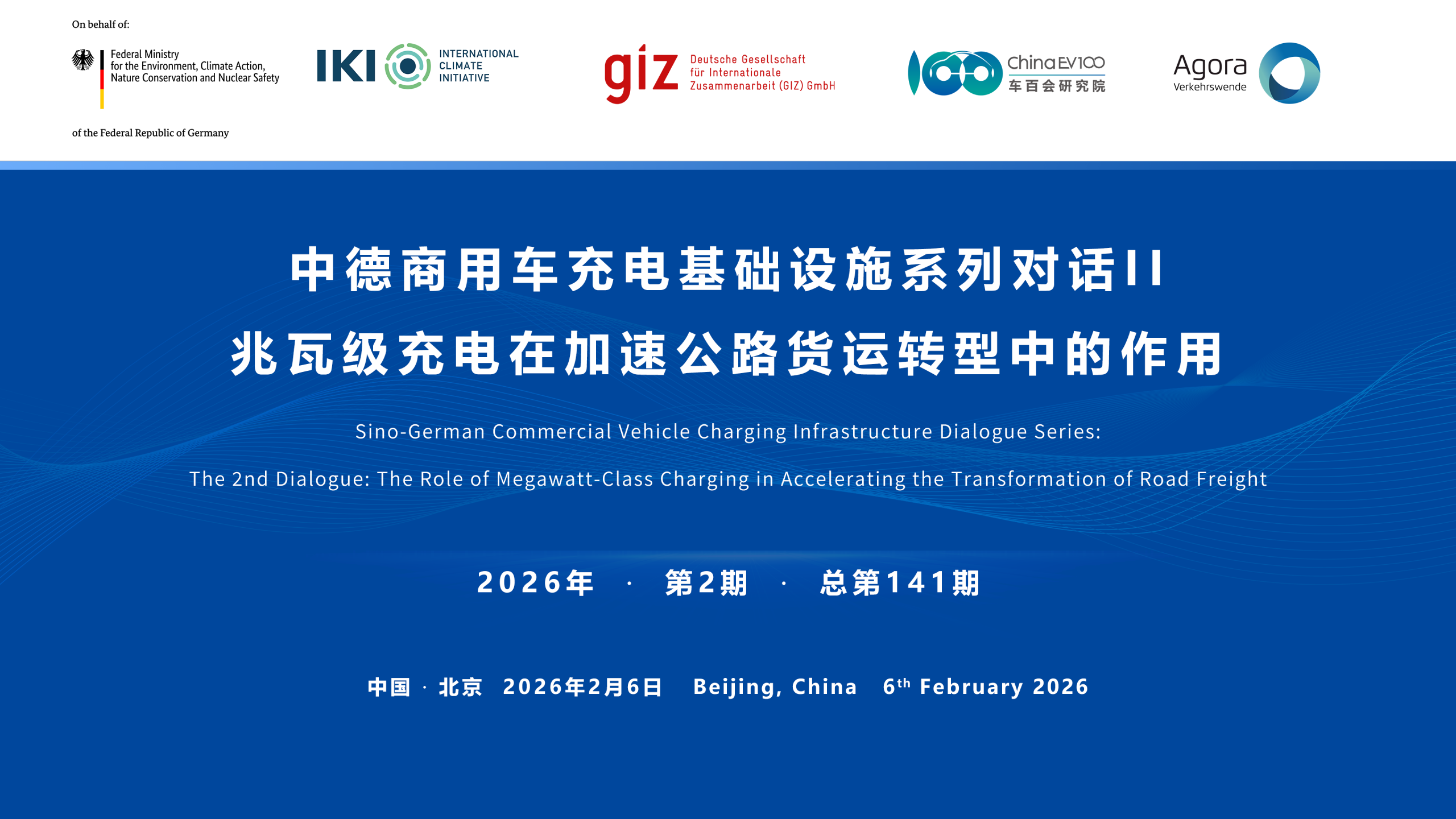
On February 6, 2026, the 2nd session of the Sino-German Commercial Vehicle Charging Infrastructure Dialogue Series was held successfully in an online and offline format. Co-organized by China EV100 and Deutsche Gesellschaft für Internationale Zusammenarbeit (GIZ) GmbH, the dialogue themed The Role of Megawatt-Class Charging in Accelerating the Transformation of Road Freight gathered leading experts and representatives from Chinese and German research institutions, industrial associations and enterprises. They conducted in-depth exchanges on core infrastructure construction priorities and cooperation directions for the electrification transformation of road freight.
The global transport sector is now in a critical phase of decarbonization, and the electrification of commercial vehicles – particularly long-haul road freight – is a pivotal breakthrough for transport emission reduction. As a core supporting technology for the electrification of heavy-duty vehicles, megawatt-class charging has become a key infrastructure driving the industry’s transformation.
Liu Xiaoshi, Director of GREEM and Vice Chairman of China EV100, hosted the dialogue. The meeting noted that China and Germany boast a solid cooperation foundation in new energy commercial vehicle technology application, charging infrastructure construction, power grid coordination and policy mechanism design. Both sides expressed the hope to strengthen experience sharing and institutional coordination through sustained dialogues to underpin policy refinement and industrial cooperation.
Li Jingzhu, GIZ representative, introduced Germany’s progress in transport and energy transition, and stressed the importance of coordinated construction of charging infrastructure for key scenarios such as long-haul trunk logistics and urban distribution.
The dialogue comprised two sessions: guiding speech and panel discussion. Focusing on the practical progress of heavy-duty vehicle electrification and charging infrastructure development in China and Germany, representatives from both sides exchanged insights on policy frameworks, technologies, market trends and future planning.
During the panel discussion, experts and representatives explored five core topics: grid capacities, space resource allocation, installation time, business model and cross-border cooperation.
On grid capacities, participants exchanged views on the impact of ultra-fast charging facilities on power distribution systems in highway scenarios, as well as capacity expansion mechanisms and investment models. They agreed that power grid access conditions and expansion mechanisms are key factors influencing project progress, and enhancing the coordinated planning of power grids and charging infrastructure is of practical significance.
On space resource allocation and installation time, the two sides shared national practices in land acquisition, approval procedures and power grid access permits. Participants pointed out that optimizing approval processes, clarifying responsibility division and improving the efficiency of power supply scheme confirmation will help shorten project implementation cycles.
On business models, representatives discussed public support mechanisms, market-oriented financing tools and operational efficiency improvement. It was agreed that in the initial stage of industrial development, integrating the public policy support and market mechanisms will boost the sustainability of infrastructure investment.
On technology and standard coordination, the two sides reviewed existing cooperation foundation in V2G and other fields and exchanged views on the megawatt-class charging systems and relevant technical standards.
On cross-border cooperation, representatives proposed deepening bilateral cooperation through pilot projects, data sharing and institutional alignment, and exploring replicable experience and models for other countries.
This dialogue has built a professional platform for in-depth exchanges between China and Germany on megawatt-class charging and road freight electrification. All participants stated that they will continue to leverage this dialogue mechanisms to advance cooperation and commercialization and jointly drive the green and low-carbon development of the global commercial vehicle industry.


