


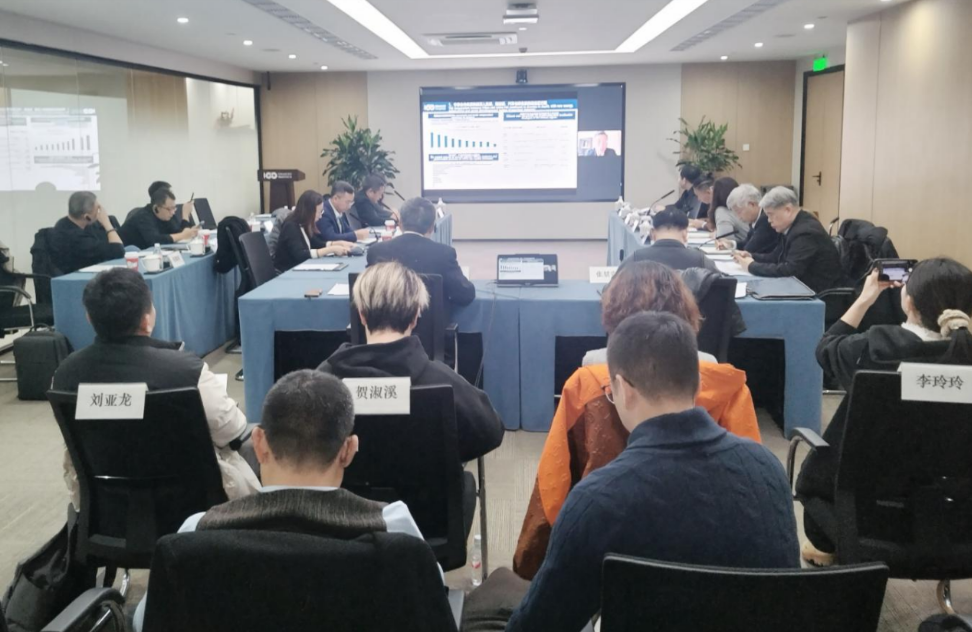
On November 19, 2025, the China Automotive Industry Global Development & Cooperation Seminar: Africa in Focus was successfully held in Haidian, Beijing. Co-hosted by China EV100 and ZGC Science City and organized by the Going Global Cooperation Platform (G100), the event was moderated by Liu Xiaoshi, Vice Chairman of China EV100 and Director of GREEM. Zhang Yongwei, Chairman of China EV100 and Executive Chairman of GREEM, delivered the opening speech.
Held in a hybrid online-offline format, the event gathered over 40 participants, including foreign officials and experts from Cameroon’s Ministry of Transport, Ministry of Industry, Chad’s Ministry of Commerce, Nigeria’s African Development Agency and, Ministry of Transport, Morocco’s Béni Mellal-Khénifra Region, Moroccan Embassy in China, and the China-Africa Cooperation and Innovation Center; Zhang Jing’an, former Secretary-General of the Ministry of Science and Technology, and Academician of the International Eurasian Academy of Sciences; Sun Xiaohong, Secretary-General of the Automotive Internationalization Committee at CCCME, and representatives from enterprises such as Chery, Sungrow, Sunwoda, LONGi, Cheche Technology, CJNOO, DST, and ZGC Science City.
Zhang Yongwei noted that China and Africa have maintained strong cooperation in infrastructure, energy, telecommunications, and industrial development, with emerging focus on new energy, vehicles, and energy storage. Given Africa’s challenges—including limited power supply, high electricity costs, underdeveloped charging infrastructure, and energy security concerns—“solar-storage-charging-vehicle” solutions have become a key collaborative approach, aligned with both sides’ development needs and shared interests. Additionally, leveraging China’s technological strengths, new vehicle models, and supply chain capabilities to support African countries in building local brands through diverse cooperation models is another important pathway.
1. Solid Foundation and Strong Willingness for China-Africa Automotive and Related Industry Cooperation
Participants agreed that China-Africa industrial cooperation has unique advantages: high willingness, strong complementarity, and a solid foundation. African countries urgently need transportation upgrades, energy transition, and industrialization, which offer significant market potential. They highly value China’s expertise in NEVs, photovoltaics (PV), energy storage, new energy power, electric vehicles, infrastructure, modern industrial parks, and urban management systems.
China’s experience in NEVs, PV, and energy storage complements Africa’s market potential. BYD, Geely, GWM, and others have entered the African market through vehicle exports; Huawei, TELD, and other infrastructure firms are actively building and operating charging networks. With the AfCFTA and China-Africa’s “Ten Partnership Actions for Jointly Advancing Modernization” in place, both sides have established strong policy, economic, and technological cooperation foundations. Driven by high mutual interest and mature conditions, China-Africa green energy cooperation will enter a new phase of deep “technology-industry-finance” synergy over the next five years.
2. Benefit Sharing and Win-Win Cooperation: Core for Long-term Cooperation
Enterprise representatives noted that as Chinese brands rapidly gain market share, the traditional “product export” model is no longer sufficient for Africa’s evolving needs. A shift to “localization and ecosystem building” is essential to achieve win-win cooperation.
On one hand, promote localized production and full-life-cycle service networks through joint ventures, local assembly plants, supply chain systems, and supporting automotive finance and after-sales services. This will help African countries build local manufacturing capacity and new energy industrial ecosystems. At the same time, advance Africa’s shift from consumer to partner by establishing joint R&D centers and innovation platforms tailored to local needs and conditions. Foster collaboration between Chinese and African universities and enterprises to accelerate industry-education integration and technology transfer, launch a China-Africa New Energy Industry-Education Alliance, and expand localized vocational training. Embed education into Africa’s NEV value chain to strengthen local institutions’ ability to train talent for green transportation development.
3. Great Potential of the “Solar-Storage-Charging-Vehicle” Innovative Model
Aligned interests are key to advancing China-Africa cooperation. Participants from both sides identified the “Solar-Storage-Charging-Vehicle” model as the most strategic and implementable innovation for new energy collaboration. It meets the demand from Africa’s public transportation and logistics sectors for low-carbon, cost-effective, and reliable electrification, while harnessing solar potential to drive a greener, more sustainable energy transition—delivering strong economic, social, and environmental benefits. At the same time, it creates a new path for Chinese enterprises in integrated transportation and energy development, offering fresh opportunities for industry growth.
This event marks the beginning of deeper China-Africa cooperation in transportation, automotive, and energy sectors. Going forward, China EV100 will work with G100 to advance joint research and promote broader, deeper collaboration in policy alignment, industrial synergy, energy infrastructure development, market expansion, service systems, and cooperation model innovation across the new energy and related industrial chains.


