


On November 27, 2025, the China-Sweden Seminar on Intelligent Connected Vehicle Development Experience Sharing, co-hosted by the China EV100, GREEM, and the Trafikverket (Swedish Transport Administration), was successfully held. Moderated by Liu Xiaoshi, Vice Chairman of China EV100 and Director of GREEM, the event brought together government representatives, industry experts from research institutions and universities, and leading enterprise delegates from both countries. Participants included Trafikverket’s Electrification Bureau, Beijing High-Level Autonomous Driving Demonstration Zone, Tsinghua University, Logistikia, NTM, Yinwang, CiDi, Pony.ai, Scania, Logivity, and Truczter. They exchanged in-depth insights on key topics including ICVs, vehicle-road-cloud integration, autonomous driving commercialization, green logistics, and standard and regulatory coordination, exploring pathways for bilateral cooperation in intelligent transportation.
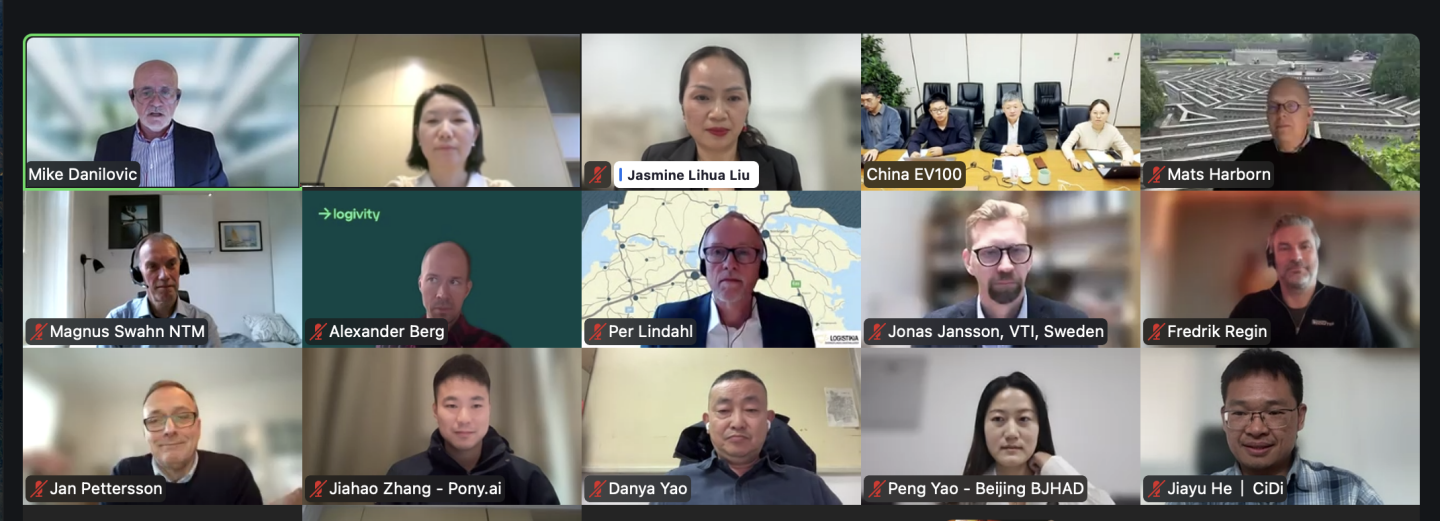
China and Sweden have established a solid foundation for cooperation in ICVs and green transportation. Since Trafikverket launched the Sweden-China Bridge initiative in 2020, collaboration has advanced across electrification, autonomous driving, and vehicle-road coordination through universities, research institutions, and enterprises. Multiple seminars have been hosted on battery swapping and energy, and research on low-carbon development and China’s autonomous driving progress is ongoing. Centered on knowledge sharing, this initiative integrates policy, technical, and industrial perspectives, laying the groundwork for a trusted and complementary innovation ecosystem between the two countries.
China and Sweden have pursued distinct paths while aligning on a shared strategic vision. China is advancing vehicle-road-cloud integration and intelligent infrastructure, with large-scale tests and commercial pilots in Beijing Yizhuang and along the Beijing-Xiong’an Expressway. Over 55% of new vehicles now feature L2-level ADAS, and L3/L4 autonomous driving is set to roll out gradually from 2025 to 2035. Sweden, leveraging its engineering strength and coordinated governance, is integrating efforts across Trafikverket, VTI, Vinnova, and RISE. It focuses on data systems, smart road maintenance in winter, autonomous shuttle applications, and assessing public acceptance and sustainability. Both countries view intelligent transportation as priorities to improving efficiency and achieving carbon neutrality.
Bilateral cooperation will move from experience sharing to deeper synergy. Technically, collaboration will focus on perception systems, V2X communication, all-solid-state batteries, and AI-driven autonomous driving algorithms. On regulation, mutual standards recognition—such as charging and swapping interfaces, data security, and autonomous driving test permits—is a key priority. Joint talent cultivation and co-established laboratories are now on the agenda. For example, Chinese participants proposed bringing mature solutions like electric heavy-duty trucks and integrated solar-storage-charging-swapping systems to Sweden.
Intelligent transportation depends on strong ecosystem support. Huawei’s strategy of “Asist Automakers Development” and Pony.ai’s five-factor model—technology, policy, production, operation, and confidence—both emphasize business collaboration. Scania has launched its Next Era truck series in China, combining European standards with China’s digital ecosystem. Platform companies like Legility and Truckster use data connectivity, AI optimization, and trust mechanisms to improve freight utilization and carbon efficiency. These efforts demostrate that the future of intelligent transportation relies not only on vehicle intelligence but also on integrated “vehicle-road-cloud-cargo-energy” synergy to create an efficient, safe, and sustainable transport network.
China-Sweden cooperation is poised to set a global benchmark for green and intelligent transportation. Moving forward, the two sides will strengthen collaboration based on complementary advantages, experience learning, and joint standard development, exploring replicable business models in areas like low-altitude economy, port logistics, trunk freight, and urban microcirculation. To address common challenges—such as cybersecurity risks, energy infrastructure bottlenecks, and transformation pressure—a regular dialogue mechanism should be established to advance policy trials, technical validation, and industrial implementation in parallel. As experts noted, this transformation is not a solo effort but a shared journey: only by creating synergy can we achieve a smarter, cleaner, and more resilient transport future.


