


On November 13, 2025, the “1st Sino-German Commercial Vehicle Charging Infrastructure Dialogue,” co-hosted by China EV100 and Deutsche Gesellschaft für Internationale Zusammenarbeit (GIZ), was successfully concluded. Held in online and in person, the event brought together nearly 20 experts and representatives from Chinese and German research institutions, energy companies, charging and swapping service providers, and vehicle manufacturers. Together, they exchanged insights on key topics including policy planning, industrial development, technical pathways, grid adaptation, and innovative multi-scenario solutions for commercial vehicle electrification.
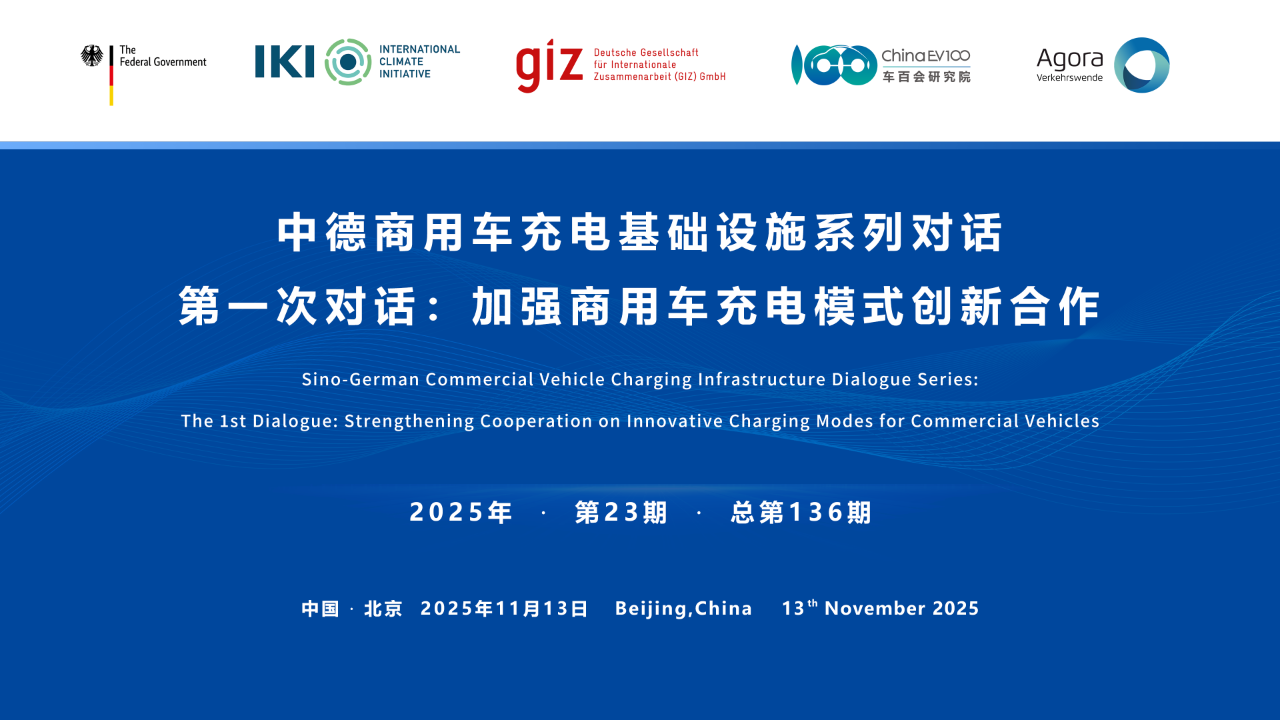
The dialogue was hosted by Liu Xiaoshi, Vice Chairman of China EV100 and Director of GREEM. In the opening remarks, Zhang Yongwei, Chairman of China EV100 and Executive Chairman of GREEM, and Urda Eichhorst, Director of GIZ China’s Transport and Urban Development Department, share a common vision: the electrification of commercial vehicles—particularly in road freight—is a vital step toward transportation decarbonization and energy transition. China and Germany each have unique advantages in technology innovation, infrastructure construction, policy frameworks, and market mechanisms. They expressed expectations for promoting the implementation of demonstration projects and standard alignment through this institutionalized dialogue platform, paving the way for a greener, more sustainable transportation.
-------------------------------------------------------------------------------------
Zhang Yongwei noted that the electrification of China’s commercial vehicle sector is gaining momentum. Early forecasts indicate that new energy heavy-duty truck sales will reach 200,000 units by the end of this year. Meanwhile, many Chinese OEMs and component enterprises aim to explore diverse cooperation with German and European partners in technology, production, and branding, opening up broad space for Sino-German cooperation.
Urda Eichhorst further emphasized that both sides should seize the historic opportunity of commercial vehicle electrification. By building international dialogue and cooperation, we can exchange valuable experiences, jointly overcome challenges in charging infrastructure, and ultimately achieve win-win development.
In the keynote speech session, guests including Fang Haifeng, Chief Expert of China Automotive Technology and Research Center, Virginia Lorraine Christochowitz, Manager of Germany Centre for Charging Infrastructure, and Liu Dan, Deputy Secretary-General of China Battery Swapping Heavy-Duty Truck Alliance, shared their insights on the latest advancements in NEV commercial vehicle policy planning, infrastructure construction, operation, technical standards, fast charging, and battery swapping models—drawing from their respective research and practical experience in China and Germany.
The roundtable discussion, hosted by Christian Hochfeld, Executive Director of Agora Verkehrswende, brought together representatives from Sino-European research institutions and enterprises such as Fraunhofer ISI, TRATON, Milence, Contargo, Beijing Transport Institute, State Grid Energy Research Institute, FAW Jiefang, Huawei Digital Energy, Sungrow, and LINCHR. They exchanged insights on policy support, cost structure, battery and power grid technology, energy supplement models, and multi-scenario application practices for commercial vehicle electrification.
Although China and Germany have different energy structures, transportation systems, and infrastructure layouts, the two countries complement each other well in technological innovation, expanding application scenarios, and business model development—offering bright prospects for future collaboration.
This dialogue marks the successful launch of the “Sino-German Commercial Vehicle Charging Infrastructure Dialogue Series”. The viewpoints shared by the participants will be compiled into subsequent research reports, serving as valuable references to support joint research and deepened collaboration on charging infrastructure between China and Germany.
Looking ahead, the two sides plan to co-host series of dialogues in January and May next year, continuing to strengthen exchanges on standards mutual recognition, technology R&D, demonstration projects, grid coordination, and innovative financing models—working hand in hand to advance commercial vehicle electrification and build a greener transportation system together.


