


On the morning of May 14, 2026, the high-level dialogue session of the Global Future Mobility Conference (GFM2026), co-hosted by the Thailand Board of Investment (BOI), China EV100, and the Global Renewable Energy and Electric Mobility (GREEM), was held at the Bangkok International Trade & Exhibition Centre (BITEC). This high-level dialogue focused on topics including the localized transformation and development of Thailand's automotive industry chain, the cultivation of an intelligent automotive industry ecosystem, and the development of new transportation energy infrastructure. The session brought together over a dozen industry representatives and experts from China and Thailand. Through three high level roundtable dialogues, participants conducted in-depth analysis of pain points in the transformation of Thailand's automotive industry chain and discussed new pathways for balancing localized and international development in the era of electrification and intelligentization. Zhang Yongwei, Chairman of China EV100 Think Tank, attended the forum and delivered opening remarks.
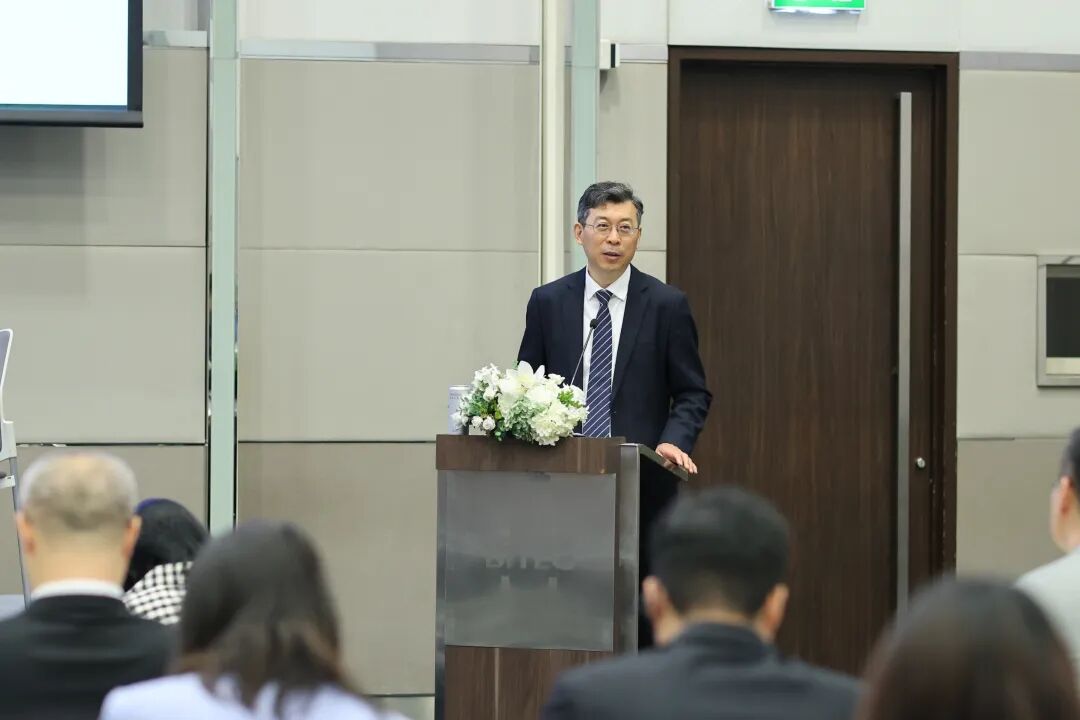
Zhang Yongwei, Chairman of China EV100 Think Tank
Dialogue I: Localized Transformation and Development Model of Thailand's Automotive Industry Chain
The first roundtable dialogue was moderated by Dr. Kitchanon Ruangjirakit, Lecturer of the Department of Mechanical Engineering at King Mongkut's University of Technology Thonburi (KMUTT). Five guests engaged in in-depth discussion on the "Localized Transformation and Development Model of Thailand's Automotive Industry Chain."
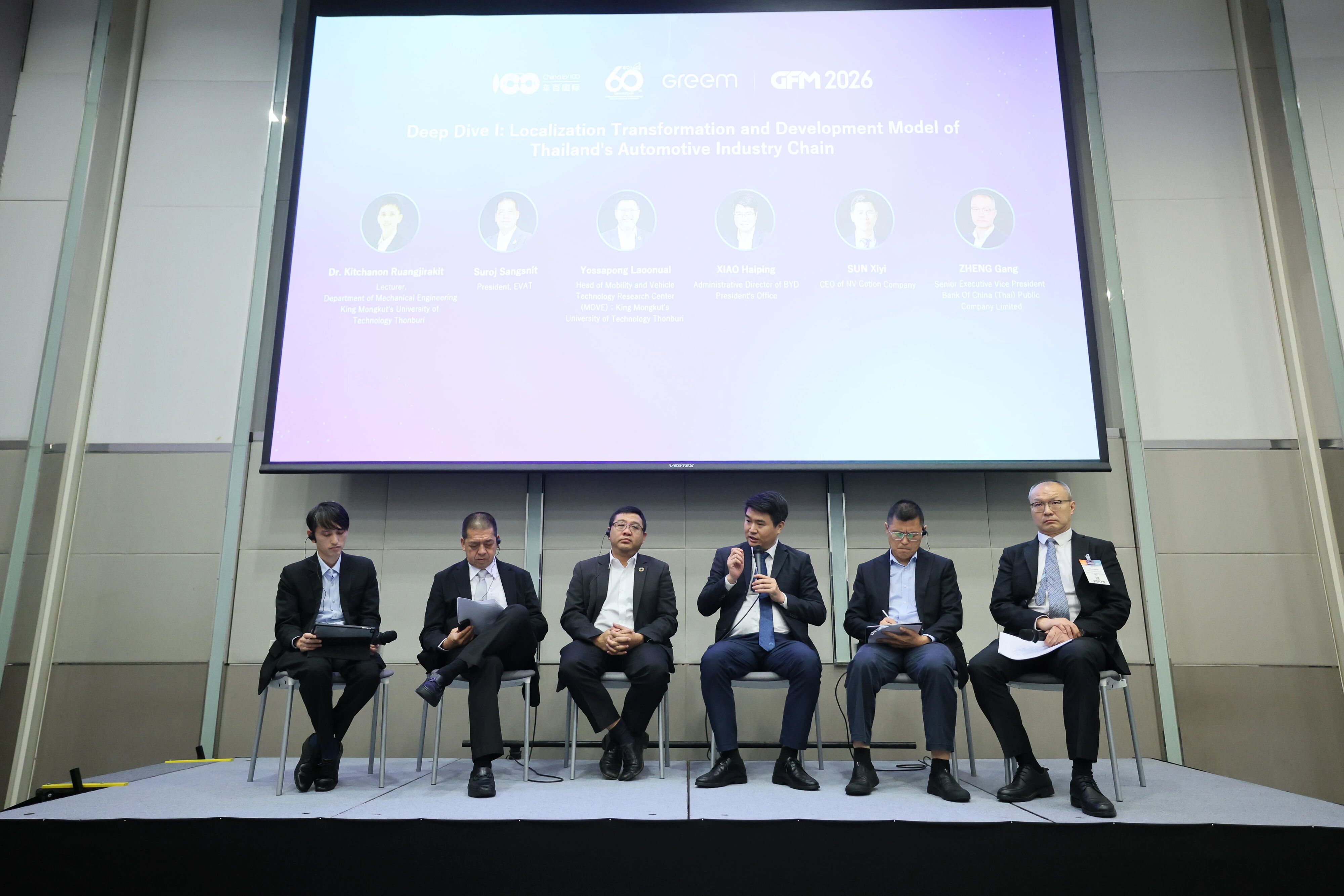
Suroj Sangsnit, President of the Electric Vehicle Association of Thailand (EVAT), noted that competition in the NEV sector has shifted from hardware specifications to intelligent ecosystems. Intelligentization is not only applied to vehicles themselves but also needs to be integrated with the environment, requiring Thai suppliers to proactively embrace the wave of intelligentization.
Dr. Yossapong Laoonual, Director of the Mobility and Vehicle Technology Research Center (MVTRC) at King Mongkut's University of Technology Thonburi (KMUTT), noted that Thailand's passenger vehicle electrification penetration rate approached 20% last year, with the EV3.0 and EV3.5 policies having accumulated successful experiences. He suggested that going forward, instead of over relying on policies and regulations, efforts should focus on encouraging cooperation between Chinese and Thai enterprises to jointly promote the continued deployment of electrification and intelligentization technologies.
Xiao Haiping, Executive Director of the Administration Department of BYD's President Office, drawing on China's experience, pointed out that electrification represents the "first half" while intelligentization represents the "second half" of the industry's transformation. China's penetration rate took about 20 years to grow from 1% to 50%, whereas Thailand's penetration rate reached 20% from zero in only about three years, demonstrating a faster transformation pace. He shared BYD's localization practices in Thailand. Since its plant commenced operations approximately 20 months ago, it has cumulatively produced 80,000 passenger EVs, with the proportion of local employees exceeding 93%. BYD has trained over 300 local engineers and more than 4,000 skilled workers. The localization rate has increased from approximately 45% two years ago to about 50% last year, reaching as high as 54%. BYD has also achieved vehicle exports to more than ten countries and regions across Asia Pacific and Europe. Going forward, BYD will continue to deepen its presence in Thailand, helping the country consolidate its strategic position amid the global industrial transformation and setting a benchmark for China Thailand NEV industry cooperation.
Sun Xiyi, President of Gotion High-tech (Thailand), from the perspective of battery technology, noted that high energy density, safety, intelligent management, and ultra fast charging represent the core directions for battery technology. Gotion has already achieved ultra fast charging technology capable of charging to 80% in five to seven minutes. Regarding supply chain localization, the company's local team localization rate in Thailand exceeds 90%, and it has held negotiations with more than 50 local suppliers, of which about 30% are Thai owned enterprises. He called on the Thai government to introduce more dedicated policies to support the development of new energy and intelligentization.
Zheng Gang, Deputy Chief Officer of Bank of China (Thailand) Co., Ltd., from the perspective of financial services, proposed that supporting localization should focus on four key principles: reducing costs for core enterprises, providing efficient delivery, ensuring strategic synergy, and finding reliable partners. He noted that Bank of China can leverage its global network to provide automotive enterprises with full lifecycle, full industrial chain services covering plant construction, sales, supply chain financing, and global cash management. In particular, RMB related treasury products represent Bank of China's unique advantage. Additionally, through its "one access point, global response" global service platform, Bank of China can facilitate business matchmaking between Chinese and Thai clients. Bank of China has actively assisted domestic enterprises with A+H share listings and bond issuance financing, and in the future, it can provide similar capital market collaboration in Thailand, helping both sides achieve win win cooperation.
Dialogue II: Development Pathways for Thailand's Automotive Intelligentization Industry Ecosystem
The second roundtable dialogue focused on "Development Pathways for Thailand's Automotive Intelligentization Industry Ecosystem" and was moderated by Liu Xiaoshi, Vice Chairman of China EV100 Think Tank and President of China EV100. The participating guests agreed that as the electrification foundation becomes more stable, intelligentization will become the key driver for the advancement of Thailand's automotive industry.
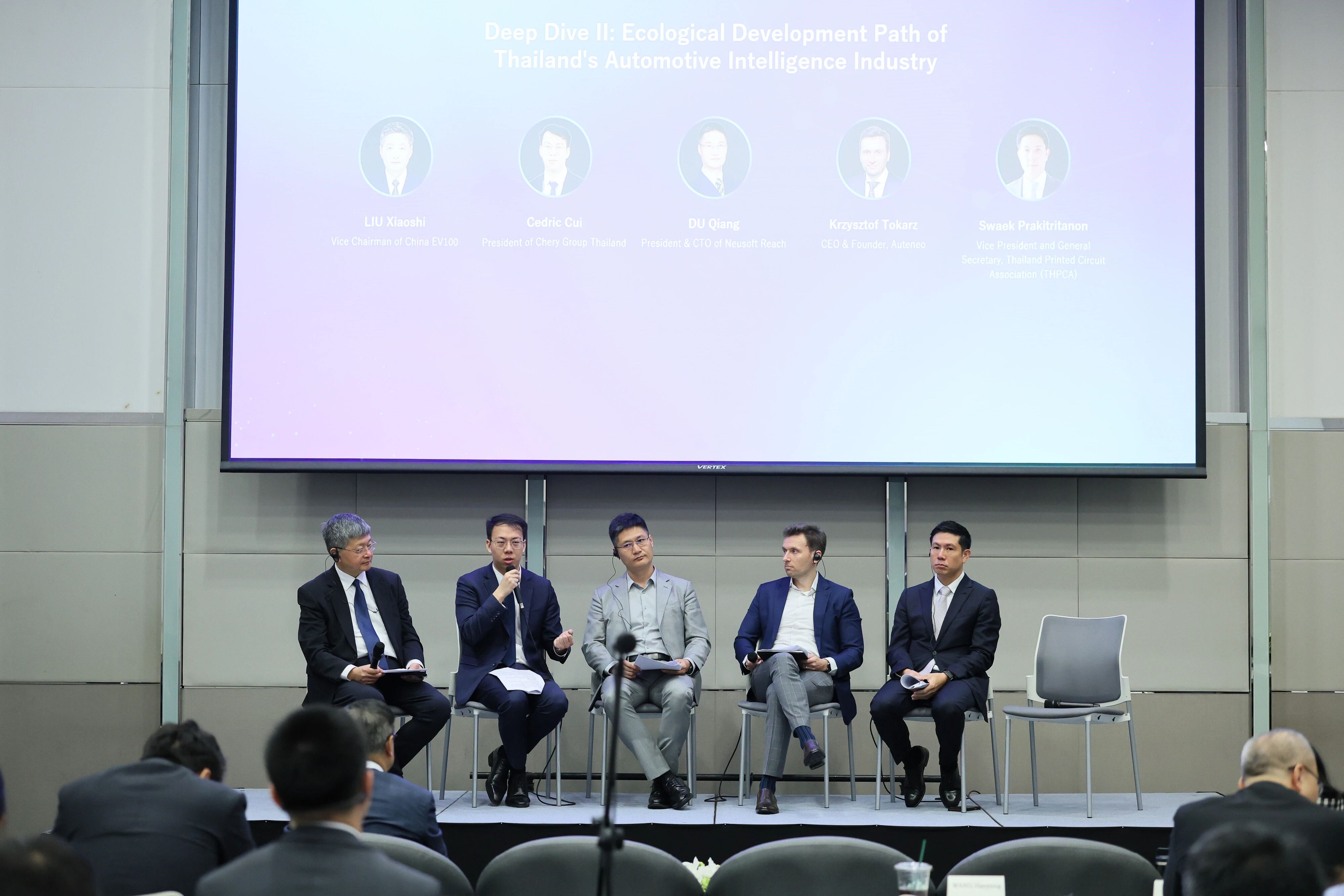
Cui Junyuan, General Manager of Chery Thailand, emphasized that safety represents the core value of intelligent driving. Thailand's regulatory authorities have already made it mandatory for locally produced NEVs to be equipped with advanced driver assistance systems such as automatic emergency braking (AEB) and lane keeping assist (LKA). Chery is combining road data accumulated in China with local testing in Thailand to advance its transition from L2 to L2.5, and will gradually expand testing under government supervision.
Du Qiang, President and Chief Technology Officer of Neusoft Reach (Neusoft Automotive), pointed out that the automotive industry is transitioning from "software defined" to "AI defined." For Thailand, a major automotive manufacturing country, establishing a localized intelligent development pathway is particularly important. Thailand, as a geopolitically neutral and friendly region, also possesses unique advantages to become an export hub for intelligent vehicles. He recommended that the Thai government maintain an open and friendly policy environment and start by cultivating end consumer habits to lay the foundation for an intelligent connected vehicle ecosystem.
Krzysztof Tokarz, Founder and CEO of Autheno, analyzed social media data for Thailand's top ten best selling EV models in Q1 2025 and found that discussions related to infotainment and software accounted for 60% of the total, far exceeding other categories, with nearly half being negative feedback. This indicates high consumer expectations for intelligent experiences, yet pain points remain. He called on the Thai government to introduce dedicated policies for the automotive software sector as soon as possible to seize the industrial opportunities brought by physical AI and autonomous driving.
Swaek Prakitritanon, Vice President and Secretary General of the Thai Printed Circuit Association (TPCA), from the hardware foundation perspective, noted that Thailand's PCB production capacity ranks second globally, with over 55% of the world's top 50 PCB companies having established factories in the country. Over the next three years, the focus will shift toward upgrading high density interconnect (HDI) boards and IC substrate packaging to support the large numbers of chips and sensors required for intelligent driving. He recommended establishing sandbox projects in regions such as Udon Thani and Chiang Mai, linking accident reduction technologies to tax incentives, and forming clear policy pathways for intelligent connected vehicles and smart grids.
Dialogue III: New Transportation Energy Infrastructure: Planning, Standards, Models
The third roundtable dialogue focused on "New Transportation Energy Infrastructure" and was moderated by Sun Xiansheng, President of the International Association for Energy Transition Studies (IAETS). The participating guests discussed key topics including charging standards, ultra fast charging deployment, and the integration of solar, storage and charging.
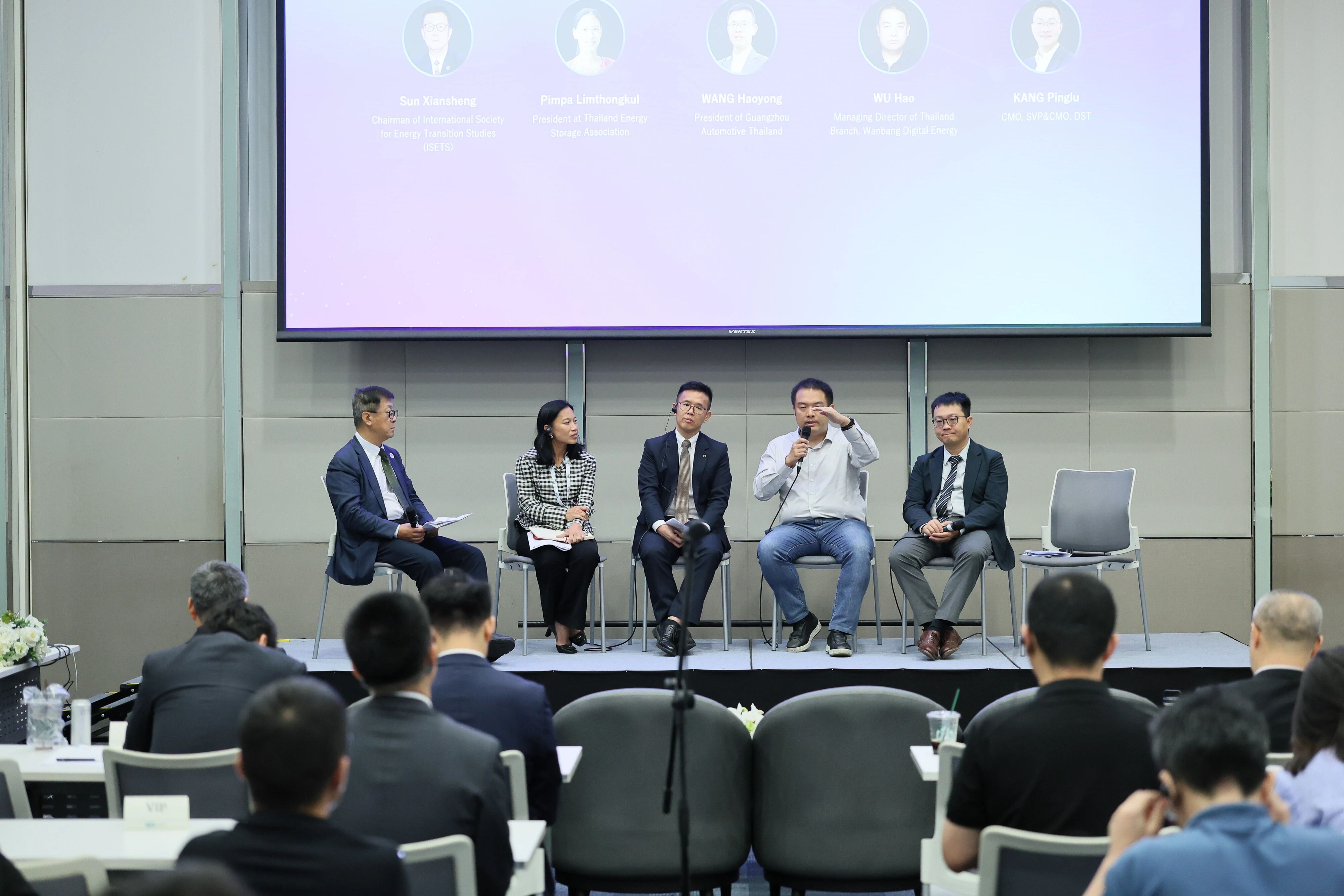
Pimpa Limthongkul, President of the Energy Storage Association of Thailand (ESAT), confirmed that Thailand has established CCS Type 2 as its charging standard, which helps reduce costs and enhance cross border compatibility. Regarding emerging microgrid and solar storage charging models, she noted that while Thailand's current electricity tariffs are relatively low and the economics of distributed solar storage systems have yet to be fully realized, as policies for grid feeding solar power become available and the Carbon Border Adjustment Mechanism (CBAM) advances, sectors such as logistics will accelerate their transition to electrification.
Wang Haoyong, General Manager of GAC International (Thailand), defined China's new energy globalization as the "2.0 phase" encompassing both mobility ecosystems and energy ecosystems. He noted that in addition to building 120 charging stations in Thailand, GAC is collaborating with partners to develop a complete energy ecosystem covering raw materials, battery processing and manufacturing, cascade utilization, and final recycling. He called on automakers, charging station operators, and power companies to break down barriers, achieve interconnection of charging networks, and work together to create a seamless charging experience for users.
Kang Pinglu, Senior Vice President and Chief Marketing Officer of DST (Dida Shangdi), addressing the issue of vulnerable power grids in emerging markets, proposed a multi layered solution integrating "solar storage charging + battery swapping + V2G." He pointed out that solar and energy storage represent indispensable supporting infrastructure for the rapid deployment of commercial vehicles. Battery swapping stations can serve as natural energy storage devices to mitigate grid impact. Additionally, every electric commercial vehicle can serve as an additional energy storage source for the grid through V2G technology. The next three years represent a critical window for validating electrification models for commercial vehicles in Thailand.
Wu Hao, General Manager of Star Charge (Thailand), frankly noted that the Thai market suffers from "power anxiety," with operators preferring to deploy higher power charging equipment. However, due to lagging policies on surplus electricity grid feed in and relatively low electricity tariffs, the investment recovery period for solar storage charging systems remains long, and their widespread application will take time. Additionally, he highlighted that language barriers and shortages of localized professional talent are the core challenges faced by Chinese charging enterprises during their initial operations in Thailand.
In the forum's concluding session, the participating guests generally maintained an optimistic outlook on Thailand's EV market. They anticipated that passenger vehicle electrification penetration could surpass the 30% target by 2030, while the commercial vehicle sector might experience a surge around 2030. Sun Xiansheng concluded by noting that the current global energy security situation has created a significant strategic window of opportunity for the EV industry, and China and Thailand should seize this opportunity jointly.
This forum provided the industry with an efficient platform for exchange and cooperation. Going forward, China EV100 will continue to serve as a bridge and link, helping Thailand achieve synergistic development between localization and globalization, promoting the healthy and orderly establishment of China's industrial chain in Thailand, and working together with Thai and Japanese capital and other stakeholders to build a stable, inclusive, and sustainable electric and intelligent vehicle industry ecosystem.


