


On April 11, the Intelligent Electric Vehicle Development Forum (2026), hosted by China EV100, was held at Phase II of the China National Convention Center.
As a key component of the forum, the morning session focused on “advancing the intelligent, green, integrated, and global development of new energy vehicles (NEVs),” while the afternoon session explored “new industrial development models and the cultivation of new competitive advantages in the automotive sector.” Representatives from government, automotive, energy, transportation, and technology sectors gathered to exchange views on the future direction of the industry.
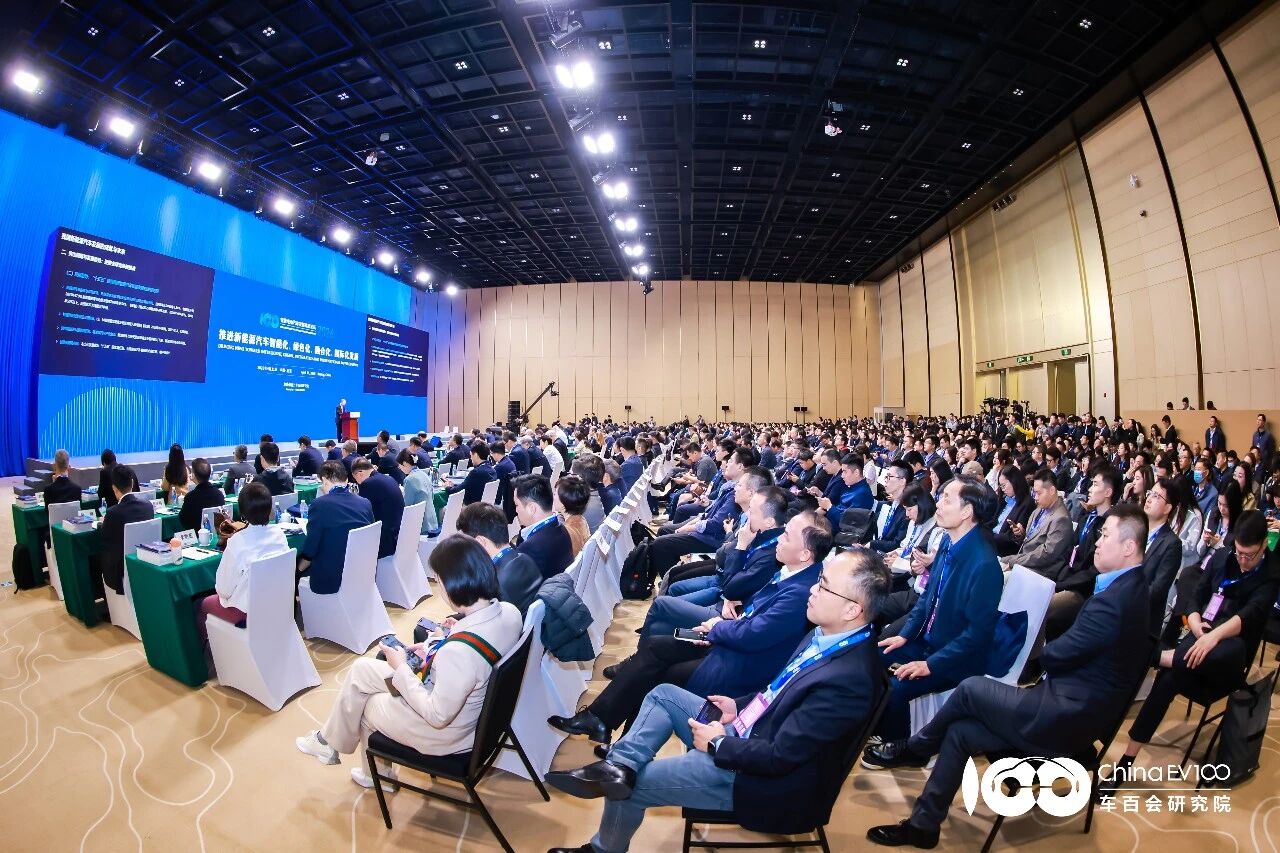
The morning session was chaired by Shi Jianhua, Vice Chairman of China EV100 and President of the China EV100 Research Institute, and the afternoon session was chaired by Liu Xiaoshi, Vice Chairman of China EV100.
Strategic Outlook for the 15th Five-Year Plan
Su Bo, Deputy Director of the National Manufacturing Power Strategy Advisory Committee and former Deputy Secretary of the Leading Party Members Group and Vice Minister of the Ministry of Industry and Information Technology, stated that the 15th Five-Year Plan period (2026–2030) will be a decisive stage for China’s transition from a major automobile country to a global automotive powerhouse.
He noted that new energy vehicles must undertake national missions including building China into a manufacturing powerhouse, a science and technology powerhouse, a transportation powerhouse, and achieving the “dual carbon” goals.By 2030, new energy vehicles are expected to become the dominant segment of the automotive market, with a domestic penetration rate exceeding 70%.
To meet national strategic requirements, he proposed advancing efforts across six key areas:
1. strengthening top-level design and coordination;
2. establishing a stable and predictable policy and governance framework;
3. achieving breakthroughs in key core technologies;
4. enhancing industrial and supply chain resilience;
5. improving infrastructure and ecosystem coordination;
6. actively participating in global governance to enhance international competitiveness and rule-setting capacity.
01 Experts and Academicians Offer Insights: Gaining Insight into Industry Transformation and Anticipating New Technological Directions
Ouyang Minggao, Professor at Tsinghua University, stated that the new energy vehicle market is shifting from price competition to value competition.
At the functional value level, the focus is shifting from parameter leadership to anxiety-free user experience; at the emotional value level, from a means of transportation to a lifestyle brand; and at the asset value level, from residual value management to full lifecycle profitability.He emphasized the need to give equal importance to these three dimensions and promote their coordinated development.
He further noted that, with technological advancements, battery electric vehicles will become increasingly dominant, alongside the widespread application of Vehicle-to-Grid (V2G). By 2030, new energy passenger vehicles will account for more than 70% of annual new passenger vehicle sales; by 2035, more than 80%; and by 2040, over 85%.
Li Keqiang, Professor at Tsinghua University, Director of the State Key Laboratory of Intelligent Green Vehicles and Transportation, and Chief Scientist of the National Innovation Center for Intelligent Connected Vehicles, emphasized that safety remains the primary issue facing the industry.
He stressed that the industry should properly recognize the technological limitations of single-vehicle autonomous driving, avoid short-term hype-driven approaches, and adhere to a systems engineering methodology. He highlighted that vehicle–road–cloud integration enables coordinated perception and decision-making across vehicles, infrastructure, and cloud platforms, thereby enhancing safety and traffic efficiency.
02 Automaker Representatives Discuss: Breaking Through Competitive Dynamics and Exploring New Development Paths for the Industry
Zhao Fei, President of China Changan Automobile Group Co., Ltd., stated that the automotive industry has shifted from competition based on single products to competition based on ecosystem value.
Feng Xingya, Secretary of the Party Committee and Chairman of the Board of Guangzhou Automobile Group Co., Ltd., stated that “green” and “intelligent” have become essential attributes of automobiles.
William Li, Founder, Chairman of the Board, and Chief Executive Officer of NIO Inc., noted that batteries and semiconductors together account for more than 50% of total vehicle costs and proposed promoting battery cell standardization and chip simplification.
Li Ming, Deputy Secretary of the Party Committee and President of Anhui Jianghuai Automobile Group Co., Ltd., proposed strengthening global supply chains, financial collaboration, and overseas risk monitoring systems.
Li Shufu, Chairman of the Board of Zhejiang Geely Holding Group Co., Ltd., emphasized that methanol-powered electric vehicles and lithium battery technologies are complementary.
Yang Xueliang, Senior Vice President of Zhejiang Geely Holding Group Co., Ltd., stated that the industry is evolving from “software-defined vehicles” to “AI-defined vehicles.”
Lian Yubo, Chief Scientist, Chief Automotive Engineer, and Dean of the Automotive Engineering Research Institute of BYD Company Limited, stated that the automotive industry is transitioning from a linear supply chain to a networked ecosystem.
He Liyang, President of Seres Group Co., Ltd., emphasized that the automotive industry is an important carrier of new quality productive forces.
Wang Lang, Vice President of Chery Automobile Co., Ltd., stated that compliance capability has become a fundamental requirement for global expansion.
Liang Linhe, Director of the Board of SANY Group Co., Ltd. and Chairman of SANY Heavy Truck Co., Ltd., stated that heavy-duty trucks account for approximately 60% of road transport carbon emissions.
An executive representative from Volkswagen Group (China), serving as Executive Vice President and Chief Executive Officer of CARIAD China, noted that the Chinese market is the largest, most complex, and fastest-changing globally.
A senior executive from BMW Group, serving as Senior Vice President, emphasized that profitability is the foundation for sustainable innovation and green development.
A senior executive from Nissan Motor Co., Ltd., serving as Member of the Global Executive Committee and Chairman of Nissan China Management Committee, stated that China plays a key role in global strategy.
03 Industry Chain Representatives Empower Development: Driving Innovation through Technology and Strengthening the Foundations of Industrial Growth
Jin Yuzhi, Senior Vice President of Huawei Technologies Co., Ltd. and Chief Executive Officer of Yinwang Intelligent Technology Co., Ltd., stated that 2026 may mark the beginning of large-scale autonomous driving deployment.
Yu Kai, Founder and Chief Executive Officer of Horizon Robotics, emphasized that foundation models for autonomous driving should be treated as core infrastructure.
Li Qiang, General Manager of the AI Automotive Industry of the Public Cloud Business Unit of Alibaba Cloud Intelligence Group, stated that automotive intelligence is evolving toward cockpit–driving integration.
Zhang Bo, Co-founder of DiDi and Chief Executive Officer of Didi Autonomous Driving, proposed hybrid mobility networks as the optimal commercialization path for Level 4 autonomous driving.
A senior executive from Baidu, Inc., serving as Vice President, stated that the industry is entering the “full inference” era of automotive artificial intelligence.
Hong Tao, Vice President of Feishu and Head of Feishu Projects, emphasized the need for digital transformation in automotive research and development.
Hou Jinlong, Member of the Board of Directors of Huawei Technologies Co., Ltd. and President of Huawei Digital Energy, emphasized the importance of megawatt-level ultra-fast charging infrastructure.
Miao Qin, Vice President of JD.com, Inc. and President of JD Auto, highlighted challenges in after-sales service systems.
Gao Dapeng, Chairman and President of Desay SV Automotive Co., Ltd., emphasized the importance of localization in global expansion.
Conclusion
From forward-looking expert insights to practical experience across the automotive and broader industry chain, the forum outlined a clear pathway for advancing the intelligent, green, integrated, and global development of the automotive industry.
Looking ahead, China’s automotive sector is accelerating toward a new stage of high-quality development, driven by innovation, openness, and deeper global integration.


