


Currently, understanding the landscape of intelligent driving expansion and further clarifying overseas strategies is a pressing concern for both domestic and international enterprises. Focusing on the theme "The Situation and Paths for China's Automotive Intelligentization Going Global," Zhang Yongwei, Chairman of China EV100,systematically analyzed the new stage, new characteristics, and new options facing Chinese automotive intelligentization in its global expansion.
A significant shift is underway in the intelligentization going global. In the past, automotive expansion was primarily focused on trade-oriented product exports, beginning with components and later evolving into vehicle exports. In the intelligent era, the pattern of going global is shifting from "single-product" to "systematic globalization." This change has just begun, but the trend has already emerged.
From "Product Globalization" to "Systematic Globalization"
Current systematic globalization is mainly reflected in three aspects:
First, intelligent vehicles and incremental components are going global simultaneously. Beyond intelligent vehicles, supply chain enterprises related to intelligent incremental components are also beginning to explore paths to global markets. Enterprises in areas such as chips and software have all initiated global expansion at various scales and levels.
Second, the application scenarios of intelligent components are expanding outward. Automotive intelligent components are no longer confined to the vehicle domain but are extending into new fields such as robotics. Supply chain enterprises that previously supplied radar systems for vehicles can now apply their components to robots. The growth of overseas robotics markets is also driving the diversified development of China‘s intelligent automotive components. This “intelligent component extension chain” presents vast development opportunities.
Third, the service chain is beginning to go global in tandem with intelligentization. The automotive service industry, upgraded through digital and intelligent technologies, is forming new international competitiveness. This includes cloud services, after-sales services, maintenance systems, and data services. Overall, intelligentization going global has moved from single-point breakthroughs to the stage of systematic globalization.
Three Major Opportunities Behind Intelligentization Going Global
The fundamental reason for this shift is the widening gap in automotive intelligentization development between China and other countries, particularly between China and markets outside the U.S., such as Europe, Southeast Asia, and emerging markets in the Global South.
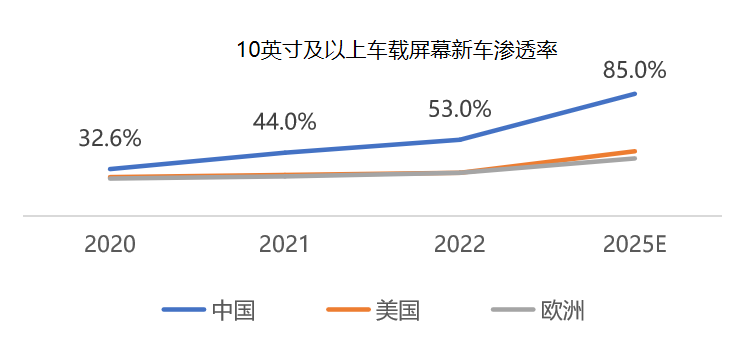
First, product gap. This can be seen in two figures: in terms of product configuration, the fitment rate of large center console screens in new Chinese cars has exceeded 85%, while the proportion overseas remains very low—less than 50% in Europe. Additionally, the penetration rate of smart cockpits in China has already exceeded 80%, whereas Europe has only reached about half. Whether it is hardware configuration or the software and service systems built around screens, a clear generational gap has formed between Chinese and foreign products, presenting a significant opportunity for Chinese intelligent products to go global.
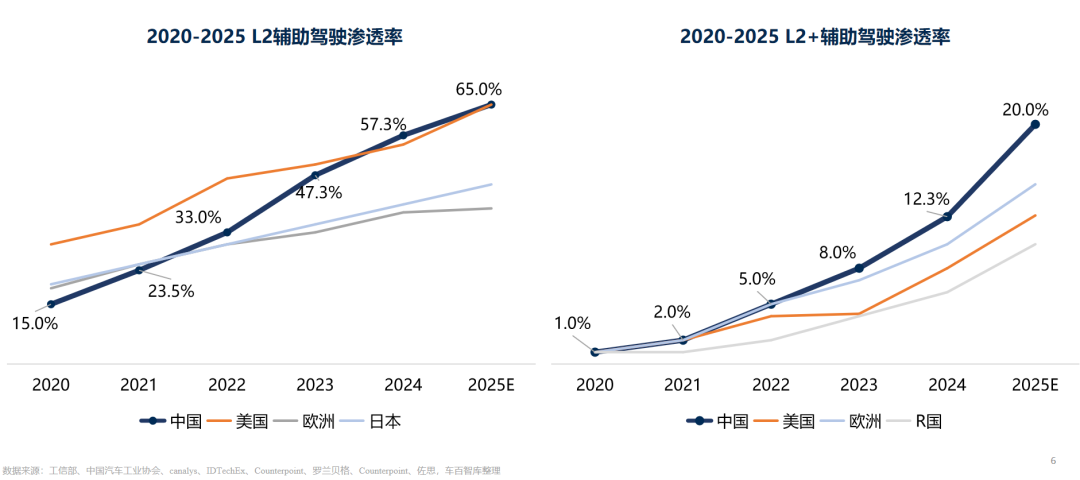
Second, technology gap. In the fields of driver assistance and high-level intelligent driving, China holds a leading position globally. The domestic penetration rate of driver assistance has exceeded 65%, and L2+ and higher-level technologies are accelerating in popularity. L3 and L4 technologies are also expected to enter large-scale application within the next year. In contrast, the overall technology landscape in Europe, Japan, and emerging markets remains significantly lagging behind.
Third, industrial chain gap. With advanced technologies in hand, can they be transformed into large-scale industrial products? This depends on the industrial capability. China's intelligent driving industry has a significant advantage in converting technological breakthroughs into large-scale deployment, characterized by short cycles and fast speed from innovation to industrialization. Take LiDAR as an example: a single unit cost around RMB 200,000 in 2017. Today, the cost of an integrated 400-line high-performance product has fallen to under RMB 1,000. A similar trend is seen with key components like intelligent driving domain controllers, whose costs have moved from “tens of thousands of yuan” to “thousands of yuan.” This ability to rapidly scale up is one of the core reasons for the fast adoption of intelligent driving.
Overall, the time lag and developmental gap across the three dimensions of product, technology, and industrial chain provide a rare window of opportunity for China's automotive intelligentization to go global.
Seven Recommendations for Driving Intelligentization Going Global
Intelligentization going global is not without its challenges. Risks and difficulties objectively exist. On one hand, there are traditional challenges such as regulatory compliance and certification systems. On the other hand, new issues have emerged, including limited awareness of new technologies and products in overseas markets, limited brand influence, and the lack of a mature usage environment in those markets. These issues are not only ones that Chinese companies have rarely encountered in the past but also entirely new challenges that many overseas markets have never faced before.
So how can we successfully navigate the path of intelligentization going global?
First, shift from going it alone to win-win cooperation. In a complex trade and geopolitical environment, the uncertainty surrounding intelligentization is even higher and more restrictive. An effective way to address uncertainty is not through solitary competition but by strengthening cooperation with overseas enterprises. Whether for OEMs or supply chain companies, going global together with outstanding overseas partners has become a realistic and mutually beneficial path.
Second, shift from exporting a single product to a holistic “product-service-solution” offering. In the past, companies focused more on product exports. However, after new technologies and products go global, they often face problems such as inadequate services, missing supporting systems, and imperfect operating entities. In the era of intelligent driving, the scope of going global far exceeds the product itself, requiring the simultaneous export of service systems and operational capabilities.
Currently, many companies have secured orders for intelligent radar, robotaxis, and even autonomous mining trucks—not a small number. Yet, during actual delivery, the biggest challenge lies in the lack of a corresponding service support system overseas, making it difficult for products to operate reliably and continuously.
Against this backdrop, the role of enterprises is transforming from pure product sellers to service providers offering comprehensive solutions, which has become a new requirement for companies in the era of intelligent driving.
Third, pursue diversified localization of manufacturing. Companies with sufficient capabilities can build their own factories independently. For those with less experience, localization can be achieved through cooperative manufacturing, technology licensing, or the export of production management expertise. For parts suppliers in particular, licensed cooperation and local production can significantly lower the barriers to market entry.
Fourth, deepen synergistic development with multinational corporations. Currently, nearly all major multinational vehicle and component companies have deeply engaged in the Chinese market and are adjusting their global strategies. Some have already put forward new strategic approaches such as “In China, For the World.” Chinese companies can leverage their global networks to accelerate their own internationalization, a unique and significant advantage of China's automotive industry.
Fifth, place great importance on R&D localization. Intelligentization R&D is difficult to complete entirely offshore. Many companies focused on intelligentization seek to conduct near-shore R&D. European countries and those in the Global South possess abundant R&D resources. Chinese companies should accelerate the establishment of R&D centers in these regions to achieve an offshore and near-shore synergistic R&D model.
Sixth, promote scenario-based globalization. Particularly in three major scenarios: shared autonomous vehicles (robotaxis), autonomous logistics vehicles, and mining-specific autonomous vehicles.
Seventh, build a global cluster and service system for intelligentization expansion. There is an urgent need to establish a cluster focused on intelligentization going global, enabling companies to complete compliance, certification, and service coordination preparation domestically. Front-loading the service system is a very pressing task at present.
(The content of this article is based on key insights from Zhang Yongwei's speech and presentation titled “The Situation and Paths for China's Automotive Intelligentization Going Global,” with minor edits.)


