


This article provides an analysis of Thailand's automotive market sales for February 2026. Subsequently, we will release in-depth country-specific auto market analyses covering Italy, Spain, Malaysia, Indonesia, Morocco, Brazil, South Africa, the UAE, Saudi Arabia, Germany, Hungary, Turkey, Mexico, Australia, and the Nordic Four (Sweden, Norway, Finland, Denmark).
The Global Auto Market Briefing by China EV100 is dedicated to panoramic insights into global automotive markets, providing first-hand data and professional analysis. Please stay tuned for further updates.
Thailand Auto Market: Jan-Feb 2026
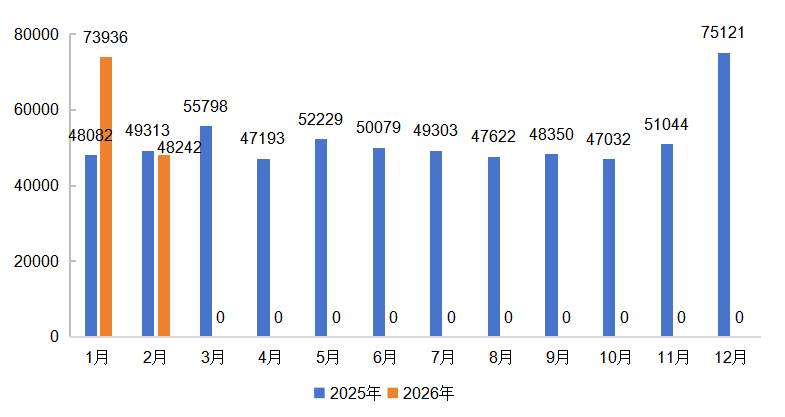
According to data from the Federation of Thai Industries (FTI), Thailand's automotive market showed signs of recovery in 2025, driven by rising demand for electric vehicles, with BEVs contributing the most to growth. Total vehicle sales for 2025 reached 621,166 units, up 8.5% year-on-year, while BEV sales stood at 120,301 units, accounting for 19.4% of total sales and representing an 80.3% year-on-year increase. During January-February 2026, total vehicle sales in Thailand reached 122,178 units, a significant year-on-year increase of 25.4%. In January, sales surged by 54% year-on-year, driven by macroeconomic recovery and concentrated deliveries before the EV3.0 policy expiration. In February, however, due to the phase-down of the EV3.5 subsidy policy and market digestion following January's demand pull-forward, new car sales fell to 48,242 units, a month-on-month decline of 34.8%.
Figure 1: Thailand Auto Sales, January 2025 - February 2026
Source: Federation of Thai Industries (FTI), compiled by EV100Think Tank
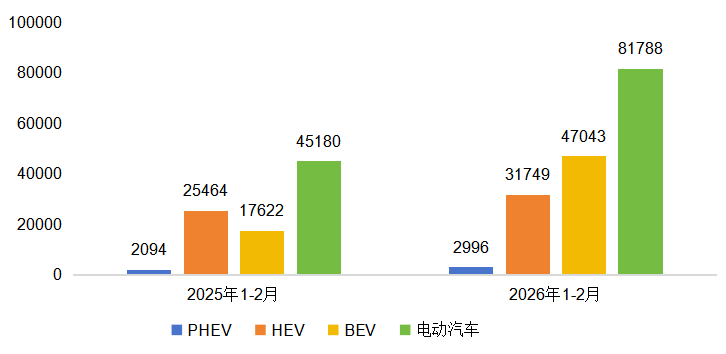
In the electric vehicle sector (including BEVs, HEVs, and PHEVs), EV registrations in Thailand reached 81,788 units during January-February 2026, up 81.1% year-on-year. BEVs, HEVs, and PHEVs registered 47,043 units, 31,749 units, and 2,996 units respectively. Due to the phase-down of the EV3.5 EV subsidy policy in February and the demand pull-forward before the subsidy expiration in January, EV registrations in February fell by over 60% month-on-month to 20,423 units, with BEV registrations plunging by over 80% month-on-month to just 4,830 units.
Figure 2: EV Registrations and Distribution, Jan-Feb 2025 vs Jan-Feb 2026
Source: Electric Vehicle Association of Thailand (EVAT), compiled by EV100Think Tank
Charging Infrastructure and Aftermarket Services
Thailand is accelerating the deployment of charging facilities, but the EV-to-charger ratio remains high. According to data from the Electric Vehicle Association of Thailand (EVAT), as of January 31, 2026, Thailand had built 4,643 charging stations and 13,977 charging units, including 8,595 DC fast chargers (accounting for approximately 61.5%) and 5,382 AC chargers (accounting for approximately 38.5%). Charging facilities are primarily concentrated in the Bangkok metropolitan area and surrounding regions, with coverage in upcountry areas and along highways still insufficient. The current number of DC fast chargers in Thailand remains inadequate to meet market demand, making fast-charging infrastructure development a major investment opportunity. The Energy Policy and Planning Office (EPPO) plans to build 12,000 DC fast chargers by 2030. By early 2026, approximately 71.6% of this target had been completed. Going forward, it will be necessary to accelerate the deployment of fast-charging stations and widely install them in convenience stores, office buildings, and other locations, following the traditional gas station model, to further improve EV support infrastructure and address infrastructure gaps.
The pressure for EV battery recycling in Thailand is increasing, and a localized recycling system urgently needs to be established. As early EVs gradually age, Thailand faces mounting environmental pressure from retired power batteries. Currently, Thailand has not yet established large-scale power battery recycling facilities, and retired batteries must be sent overseas for processing, which cannot support the sustainable development of the NEV industry. Although Thailand aspires to become Southeast Asia‘s EV manufacturing hub, its battery recycling system and supporting policies remain inadequate. To this end, the government is actively seeking foreign investment to establish power battery recycling facilities in Thailand. Additionally, the Ministry of Industry is accelerating the implementation of the Industrial Waste Management Act, which will mandate that all vehicle and battery importers establish a closed-loop battery recycling network and strictly prohibit the improper disposal and illegal discarding of used batteries.
Depreciation and rapid performance upgrades have led to a sluggish second-hand BEV market in Thailand. In 2026, Thailand has officially entered the first large-scale vehicle replacement cycle for new energy models, but the second-hand BEV market is performing poorly, imposing asset depreciation pressure on early EV owners. On one hand, the Thai new car market is experiencing the most intense price war in its history, with mainstream Chinese brands significantly cutting prices to gain market share, leading dealers to generally reject or heavily discount early models for trade-in. On the other hand, power battery technology is rapidly evolving. The average range of mainstream BEV models in Thailand was around 300 km in 2021, whereas new models launched in 2026 generally achieve ranges exceeding 500 km. Early models are now lagging behind in range, energy efficiency, and smart features. Furthermore, Thailand lacks a nationally recognized third-party battery State of Health (SoH) testing and certification agency. As consumers are unable to assess the remaining battery life or the risk of replacement costs, they remain cautious about purchasing second-hand EVs.
Chinese Automotive and Supply Chain Companies' Global Expansion Updates
Chinese brands performed strongly at the Bangkok International Motor Show, with BYD leading Chinese automakers in bookings. The 47th Bangkok International Motor Show was held from March 25 to April 5, 2026, in Bangkok, Thailand. Total car bookings reached 132,951 units, a substantial 71.8% increase from 77,379 units in 2025. With Chinese automakers such as BYD achieving localized production in Thailand, EV production capacity continues to rise, costs are further declining, and consumer acceptance of EVs is increasing. Chinese brands delivered an impressive performance at the show. Chinese brands recorded a total of 90,281 bookings during the show, accounting for 67.9% of the market, of which BYD achieved 17,354 bookings, surpassing Toyota‘s 15,750 to top the booking charts. Japanese brands recorded only 36,346 bookings, representing a 27.3% market share.
Great Wall Motor (GWM) announced an additional investment of THB 10 billion. In March 2026, the ORA 5 was launched globally in Thailand, where a representative of Great Wall Motor announced an additional investment of THB 10 billion (approximately RMB 2.1 billion) in Thailand. The investment will be used for factory expansion, supply chain optimization, and marketing network upgrades, with plans to achieve 40% sales growth in Thailand in 2026.
Steering system supplier Nexteer Automotive officially commenced production at its Thailand plant. At the end of March 2026, Chinese steering system supplier Nexteer Automotive officially inaugurated its plant in the Rayong Province of Thailand. The 5,000-square-meter plant specializes in the manufacturing of Column-Assist Electric Power Steering (CEPS) systems, filling a gap in Thailand for core intelligent control components.
Six Zhejiang-based component companies purchased land to build factories in Thailand. At the beginning of 2026, six Zhejiang-based enterprises, including Hongxin Technology and BH Technology Group, purchased land and began constructing factories in Rayong Province and Chonburi Province, covering areas such as hardware tools and auto parts. According to media reports, the total investment scale exceeds RMB 1 billion.
Authors: Li Qing, Zhang Qiang
Global Future Mobility Conference 2026 (Thailand) (GFM2026)
The Global Future Mobility Conference (Thailand) 2026 (GFM2026) will be held on May 13-15, 2026, in Bangkok, Thailand, under the core theme “Embracing Green and Smart Mobility.” The conference will consist of one main forum, three high-level dialogues, one government-enterprise exchange meeting, and two site visits. It will invite key policymakers for China-Thailand EV policies, as well as core industry stakeholders from Thailand and around the world, including industry leaders such as BYD, Changan, SAIC, Gotion High-Tech, Great Wall Motor (GWM), Chery, GAC Aion, PTT Public, VinFast Auto, Tesla, and WHA Industrial Development PLC, to discuss industry transformation trends and jointly draw a grand blueprint for the future of mobility.


